Soil Health Management Soil health principles Best cropping systems Soil management practices Precision agriculture
Soil health management
1) Soil health principles
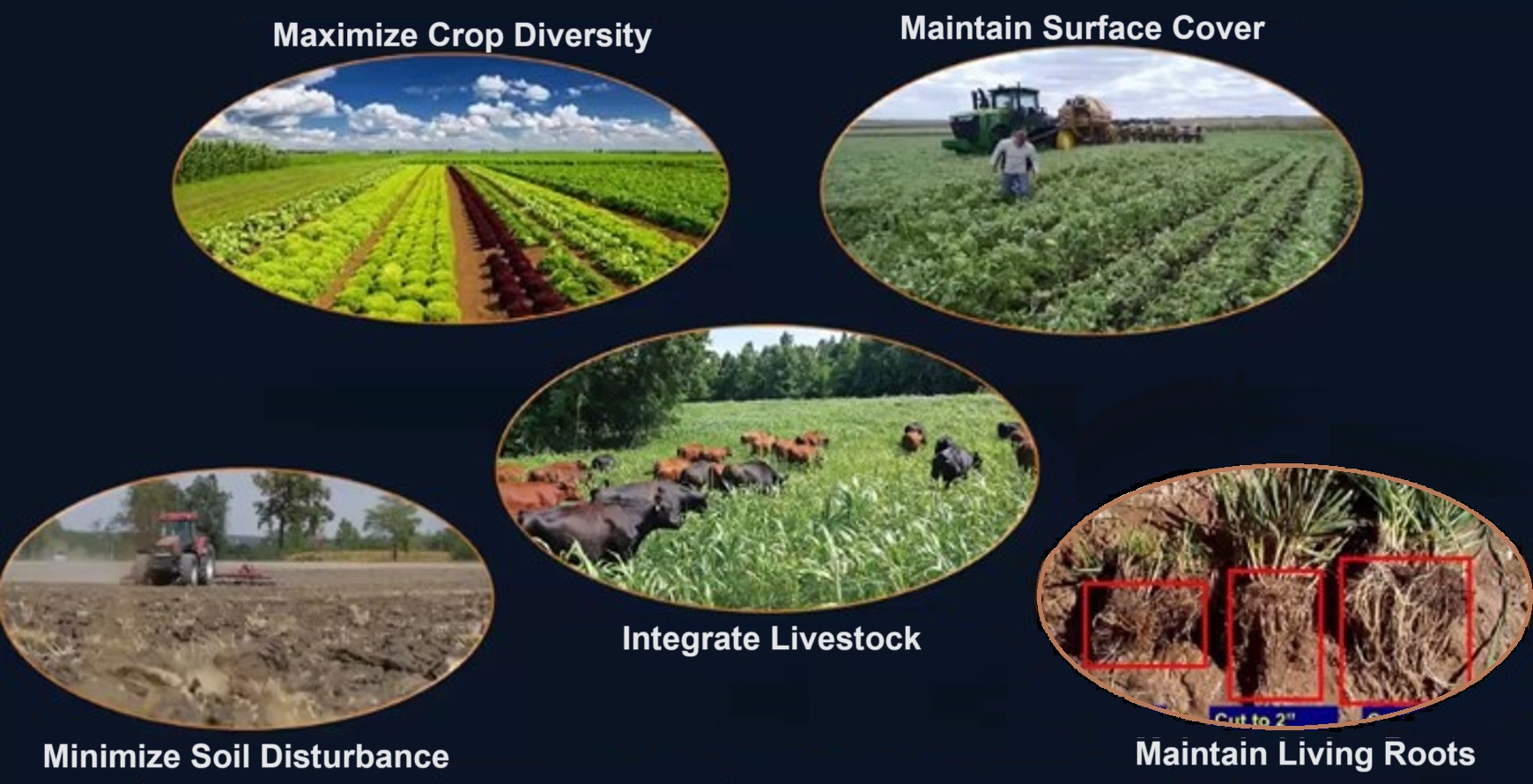
The USDA-NRCS defined five basic land and soil management principles to maintain and improve soil health (Figure 1).
Soil armor: to keep the soil covered as much as possible with living plants, crop residues, compost, or synthetic tarps
Minimizing soil disturbance: to reduce the introduction of mechanical disturbance (e.g., tillage), chemical disturbance
(e.g., pesticide application), and biological disturbance (e.g., overgrazing) to soil
Maximizing plant diversity: to grow different crops on farmland in order to suppress disease and pest incidences and sustain a fully
functioning soil food web
Maximizing live plant/root: to keep a living root growing throughout the year is critical to increasing soil biodiversity, achieving
high microbial activity, and controlling soil erosion
Livestock integration: to include animal grazing in cover crop, crop residue, and weed management is effective for improving animal
welfare, reducing herbicide uses, promoting nutrient cycling, and decreasing cropland nutrient export
Figure 1. The five soil health principles by USDA-NRCS
2) Soil health management practices
The USDA-NRCS has been developing, implementing, and extending effective soil management practices since the 1940s to conserve soil and
enhance the soil ecosystem services in particular the crop productivity. One original mission of USDA-NRCS was to “maintain healthy and
productive working landscapes”. A suite of best soil management practices were identified to maximize the crop productivity while minimizing
the negative environmental impacts of modern agriculture, including proper land use, appropriate cropping systems, conservation tillage,
land application of organic residues, agronomic fertilization, and engineering soil conservation structures (Guo, 2021). These practices
are precise translation in action of the five basic soil health principles and have demonstrated high effectiveness in sustaining and
enhancing soil health.
(i) Proper land use
Proper land use is the first element to consider in soil health management. The ways human beings use the land are determined by its soil
capability and influence the soil health. Lands with coarse textured soils (e.g., sandy loam) should not be used as rice paddies because
of the low water retention capability. Lands with heavy textured soils (e.g., clay and clay loam), on the other hand, are not desirable as
septic tank sites (Guo, 2021). Improper land use results generally in significant soil erosion losses and subsequently, soil health
degradation.
(ii) Crop rotation
An appropriate cropping system always involves crop rotation as two or more different crops are grown alternatingly on the same land at
different time. Corn-soybean, winter wheat-alfalfa, and corn-soybean-winter wheat, for example, are the three crop rotation systems commonly
practiced in the U.S. northeastern region]. The major benefit of crop rotation is to suppress pests and diseases in agricultural soils.
Different crops host distinct pests and soil microbes and therefore, changing crop species helps break the disease cycle in a given farmland
and thus, helps control pests and soil-borne diseases. Different crops vary in the root system, root exudates, nutrient requirements, and
nutrient cycling ability. Crop rotation, therefore, increases crop yields and improves soil structure, erosion resistance, biodiversity, C
sequestration, and the overall soil health (Guo, 2021).
(iii) Cover cropping
Cover crop is any living ground cover that is planted into or after a main crop and then commonly killed before the next crop is planted.
Planting a cover crop on fallow agricultural land is highly efficient to maintain the soil health. Cover crops are frequently found on
between-tree row-strips of orchards, in greenhouse and high tunnel nurseries between soil beds, and in crop fields during the winter season.
Common cover crop species include grasses (e.g., rye, barley, oats, ryegrass, Sudangrass, millet, and sorghum), annual, biennial, and perennial
legumes (e.g., peas, beans, alfalfa, hairy vetch, and clovers), and other broadleaf species (e.g., buckwheat, radish, canola, mustard,
marigold, and kale). Cover cropping is critically important to control soil erosion, maintain soil microbial pollution and diversity,
and enhance soil health (Guo, 2021).
(iv) Conservation tillage
Conservation tillage refers to any reduced tillage or planting systems in which ≥ 30% of the soil surface is covered by crop residues after
planting to reduce erosion by water; if wind erosion is the primary concern, >1120 kg ha-1 of flat small grain residue equivalent are on the
surface during the critical erosion period. Strip till, ridge till, stubble mulch till, reduced till, and no-till are exemplified conservation
tillage practices if the land surface coverage by plant residues meet the criteria.
Relative to conventional tillage, conservation tillage greatly reduces the mechanical disturbance of cropland soil. Conservation tillage
greatly helps conserve soil OM, improve soil structure (aggregation), and reduces soil erosion losses.
(v) Soil organic amendment
Organic matter (OM) is the single core factor that influence most of the soil health indicators. The composition and content of OM in a soil is
largely controlled by the local climate and influenced by soil texture, mineralogy, land use, and soil management. Organic amendment increases
soil OM contents by applying additional organic residues to soil. Land application of organic residues or soil amendment with plant debris,
animal manures, biosolids, composts, food processing wastes, and biochar is an effective method to increase soil OM content and improve soil
biological properties (Guo, 2021). Many organic amendments such as spent mushroom substrate, poultry litter, biosolids, and solid animal
manures and the derived biochars contain substantial levels of plant nutrients (e.g., N, P, K, Ca, Mg, and S) in addition to organic C.
Continuous, repeated land application of these organic amendments at sufficient rates would efficiently improve soil health.
(vi) Crop-range-livestock integration and rotational grazing
In a crop-range-livestock integrated system, land is used to produce crops from spring through the fall and the resulting stubbles and other
plant residues remain in the field for livestock animals such as cattle, goats, and sheep to graze in winter. Winter cover crops are another
feed source to support animal grazing. Livestock animals are raised on the rangeland during the crop growing seasons. Integration of livestock
grazing into the routine cropping system is promising to improve the farm resource utilization efficiency, reduce the demanding use of chemical
fertilizers and pesticides, and enhance soil health (Guo, 2021).
Rotational grazing can be exercised to avoid overgrazing. Rotational grazing refers to the practice of subdividing a pasture into a number
(e.g., 2–30) of smaller paddocks and only selected paddocks are grazed by animals at a time while the rest paddocks are un-grazed to allow
forage restoration. A well-managed rotational grazing program helps reduce soil erosion from perennial pastures and improve the water quality
as well as animal production.
(vii) Precision farming
Precision farming or precision agriculture refers to a data-driven, geospatial and sensor technologies-based approach to farming management that can
improve crop productivity, reduce the input needs for water, fertilizers, and pesticides, and decrease the environmental impacts of farming by
managing different parts of a crop field separately instead of "averaging." In field operations, precision technologies sense microsite
specific conditions in real-time, simultaneously measure soil and plant conditions, and automatically adjust treatments to meet each site's
unique needs for fertilizers, pesticides, and water (Figure 2). Figure 2. Precision farming using robots to monitor and tend crops
Guo, M. 2021. Soil health assessment and management: recent development in science and practices. Soil Syst.
5, 61. doi: 10.3390/soilsystems5040061
 Soil health principles